


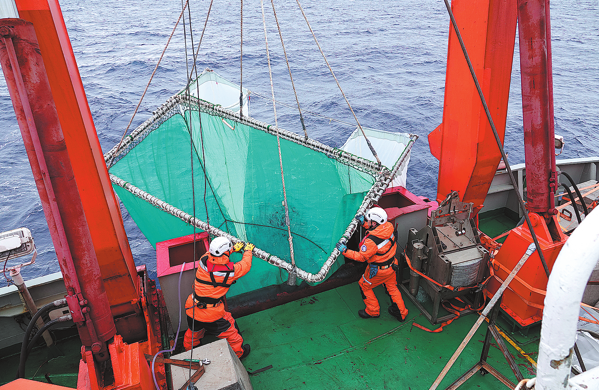
The Chinese polar research icebreaker Xuelong completed all scheduled oceanographic survey operations in the Amundsen Sea and Ross Sea on Thursday having deployed new technologies and domestically produced equipment. The operations are a part of China's 42nd Antarctic expedition.
The team aboard Xuelong, also known as the Snow Dragon, carried out a series of scientific surveys in the waters of Antarctica including the hydrological environment, marine biology, marine chemistry, atmospheric environment and penguin habitats from Jan 2, said team leader Zhang Haifeng in an interview with Xinhua News Agency.
The western parts of the Antarctic region, where the surveyed waters are located, are among the areas most significantly affected by global climate change. The ice sheets and ice shelves south of the Amundsen Sea are rapidly melting, making this area a hot spot for Antarctic scientific research on climate change, according to Xinhua.
The team overcame adverse weather conditions such as wind and snow, fog, waves and severe ice conditions to conduct ocean surveys in the target sea areas, Zhang said. "We focused on investigating key elements of the marine ecosystem and carried out operations such as the deployment and recovery of moored buoys, the use of new krill trawls and observations with expendable conductivity and temperature."
Chinese researchers collected a batch of high-value specimen such as Antarctic krill, midwater fish and deep-sea benthic organisms, which provide a scientific reference for clarifying the trophic structure of key species in the upper and middle layers of the ocean in the relevant sea areas and for tracking and understanding the trends in key population changes.
During the operations, a batch of new technologies and equipment was put to use, said team member Li Shuai. "The deployed polar ecological mooring system, equipped with domestically produced acoustic and optical detection modules, enables long-term continuous observation of the ocean beneath the ice."
Additionally, a newly improved krill trawl with a multilayered design was put to use. It has effectively increased the catch and helped the team understand the distribution of krill across different water layers, Li added.
The Xuelong ocean team comprises 31 members from 12 domestic research institutes and universities. Next, the team members will take the icebreaker to Hobart Port in Australia, before flying back to China. The Xuelong will then proceed to China's Zhongshan Station in Antarctica to carry out other tasks.
China's 42nd Antarctic expedition, organized by the Ministry of Natural Resources, relies on the Xuelong, Xuelong 2 icebreakers and various research stations to conduct a series of ocean surveys. It's an important part of China's long-term monitoring and scientific research in Antarctica, providing crucial support for studies on Antarctic climate change and the ecological environment.
Wei Fuhai, leader and chief scientist of the 42nd Antarctic expedition, said previously that China has conducted multidisciplinary surveys in the Amundsen Sea for eight consecutive years since 2018. Such long-term continuous observations are crucial for capturing the complex and rapid marine change processes in this region. The survey results will provide valuable data for assessing the impact of global climate change on marine ecosystems.
