


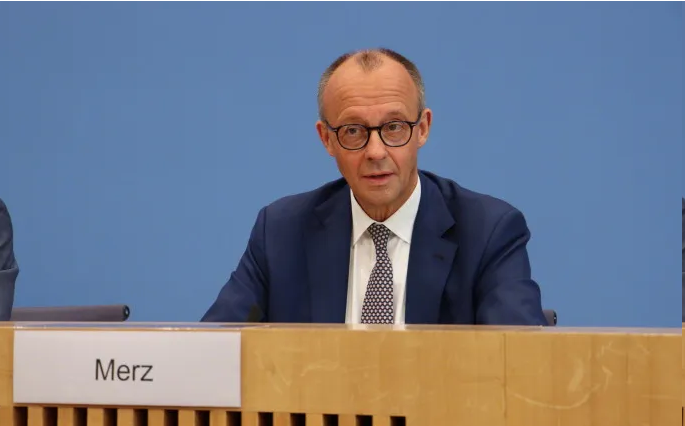
On February 27th, German Chancellor Merz addressed the state of the German economy in a speech, following his first visit to China since taking office. Merz stated that Germany's productivity was insufficient, a fact immediately apparent upon his return, and that the current work system was detrimental to Germany's economic prosperity.
Merz said, "Our productivity is indeed insufficient. Everyone says, 'I have done a lot,' and that's true. But ladies and gentlemen, if you return from China, you will realize more clearly that the work-life balance and the four-day workweek cannot sustain our country's prosperity in the long term. We must now exert more effort."
On February 25th, German Chancellor Merz arrived in Beijing, beginning his first visit to China since taking office. Merz was also the first foreign leader received by the Chinese government during the Lunar New Year of the Horse.
Upon arriving in Beijing, Chancellor Merz posted on social media in Chinese: “Berlin and Beijing are nearly 7,500 kilometers apart. For many years, we have been happy to bridge this distance. For me, maintaining and deepening our diplomatic and economic relations is of paramount importance. To achieve this goal, we need open channels of dialogue.”
Merz stated in the post: “We want to strengthen German-Chinese economic and trade relations. As two of the world’s three largest economies, bilateral economic and trade cooperation between Germany and China can unleash enormous potential and promote economic prosperity.”
On the 26th, German Chancellor Merz arrived in Hangzhou, Zhejiang Province. During his stay in Hangzhou, the German delegation exchanged views with 10 Chinese companies from industries such as artificial intelligence, humanoid robots, and new energy vehicles.
It is understood that Merz led a high-level economic and trade delegation to China, accompanied by executives from approximately 30 leading companies in Germany’s advantageous sectors, including automobiles, chemicals, biopharmaceuticals, machinery manufacturing, and the circular economy, fully demonstrating Germany’s strong desire to deepen bilateral economic and trade relations.
