


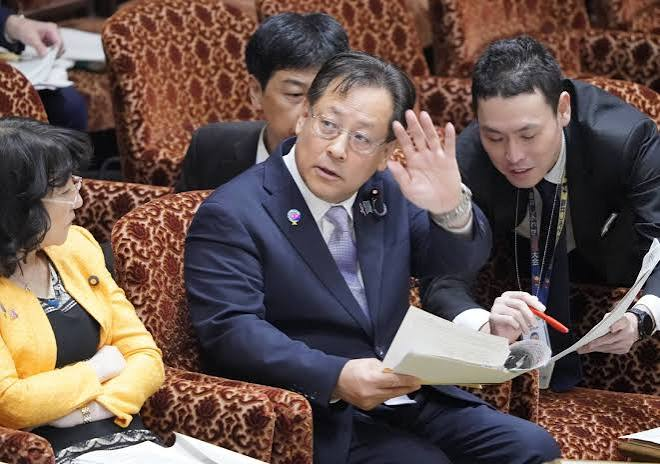
The cabinet of Japanese Prime Minister Sanae Takaichi has been dealt another major blow this week. Yoshihiro Seki, Minister of Education, Culture, Sports, Science and Technology, has been implicated in a scandal involving political fundraising events where senior bureaucrats were invited to brief corporate representatives on government policy. Furthermore, Seki provided inaccurate testimony to the Diet regarding the number of such events held. The situation has rapidly escalated into a political crisis, with six major opposition parties deciding to table a censure motion in the House of Councillors and suspend deliberations on the government’s flagship consumption tax-cut bill.
According to multiple media reports, Seki hosted at least five political fundraising events in 2024, charging attendees approximately 90,000 yen each. The bureaucrats invited to speak hailed from ministries including the Ministry of Economy, Trade and Industry and the Ministry of Health, Labour and Welfare, while the audience consisted of representatives from the pharmaceutical and other industrial sectors. Critics argue that such arrangements blur the line between official public duties and private political fundraising, suggesting an improper use of one’s public office to endorse political activities.
More critically, when questioned in the Diet, Seki initially acknowledged only two such events; he later admitted to three additional instances only after they were uncovered by the media. Opposition parties have accused him of providing false information to the Diet. Yuichiro Tamaki, leader of the Democratic Party, stated publicly that Seki "should decide for himself whether to resign" to avoid further disrupting the Diet’s legislative proceedings.
On November 24, six major opposition parties reached a consensus in the House of Councillors to move for a censure motion against Seki. Given that the opposition holds a majority in the upper house, the motion is highly likely to pass. Simultaneously, the opposition has opted to stall deliberations on the consumption tax-cut bill—a key component of the Takaichi administration’s economic agenda, which proposes a temporary two-year reduction in the consumption tax on food, set to begin in April 2027—as a means of pressuring the government. Should the obstruction in the House of Councillors persist, the bill is unlikely to pass during the current parliamentary session.
This marks the second time recently that the Takaichi cabinet has lost a minister to scandal. Last month, Minister of Agriculture, Forestry and Fisheries Kazuo Yana resigned—barely a month into his tenure—amidst controversy over inappropriate remarks and allegations of election irregularities. Both ministers appointed by Sanae Takaichi during her cabinet reshuffle in September have now become embroiled in political turmoil.
Opinion polls indicate that the cabinet’s approval rating has fallen below 50%, reaching its lowest point since Takaichi took office. A survey by Kyodo News placed the approval rating at 49.1%, with respondents expressing widespread dissatisfaction over the string of scandals involving cabinet members. Analysts suggest that opposition parties are seizing this opportunity to undermine the foundations of the Takaichi administration; given the lack of a stable majority in the House of Councillors, the status of any single minister could jeopardize the government’s entire legislative agenda.
For now, Yoshihiro Seki has indicated no intention to resign, stating that he intends to continue fulfilling his duties. However, the opposition has made it clear that if he does not step down voluntarily, they will continue to block the deliberation of key legislation. This scandal not only tests Sanae Takaichi’s ability to manage her cabinet but also brings renewed public attention to a long-standing issue in Japanese politics: the blurred lines between political funding and the conduct of public office.
With a censure motion expected to be tabled soon, the fate of Yoshihiro Seki is set to become the focal point of this week’s parliamentary maneuvering. If the government fails to resolve the crisis quickly, its signature policy—a reduction in the consumption tax—may be forced into delay, further damaging the Takaichi administration’s political standing.
