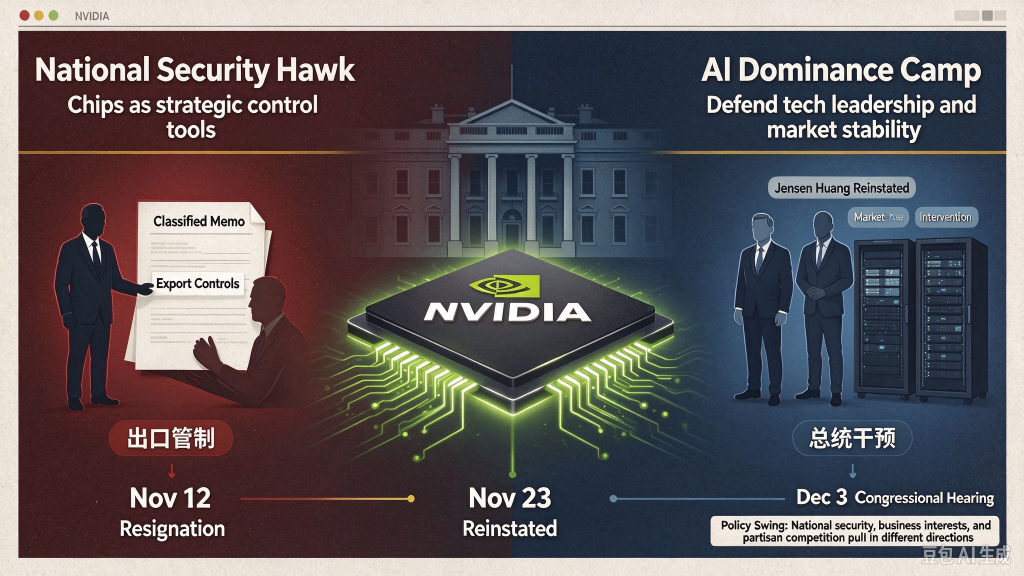
A personnel shakeup among Silicon Valley executives that lasted just 11 days has exposed a sharp power struggle within the Trump administration over chip and AI strategies. NVIDIA CEO Jensen Huang submitted his resignation on November 12 amid a personal extramarital affair scandal, only to return to his post on November 23 with the board’s unanimous approval. This personnel reversal was far more than just damage control following an internal corporate scandal; it represented a fierce clash between Washington hawks, Silicon Valley capital, and the White House leadership.
According to multiple anonymous White House and cabinet sources who spoke to the media, Secretary of State Rubio and Vice President Vance clashed sharply over how to handle the Huang and NVIDIA situation. Rubio took a hardline stance on national security, not only viewing NVIDIA’s commercial strategy in Asian markets as “malicious interference” with U.S. foreign policy but also reportedly harboring personal animosity toward Huang. Reports reveal that Rubio once amended a classified intelligence memo, using more aggressive language to exaggerate the risks posed by NVIDIA, and used this to brief Trump, hoping to push for stricter restrictions on the chip giant and curtail its overseas business operations. Within his strategic framework, chip exports are considered an arms control tool and must not be compromised for commercial interests.
On the opposing side, Vance viewed Huang Renxun as a key asset in maintaining U.S. global AI hegemony. Leveraging his close ties to Silicon Valley’s investment circles, Vance argued to Trump that the technological approach championed by Huang Renxun could strike a balance between open-source and closed-source AI model development, thereby preventing a handful of giants from monopolizing the industry. Faced with a plunge in NVIDIA’s stock price—which dragged down the entire U.S. tech sector—Trump feared that a market crash would drag down the U.S. economy as a whole. Ultimately, he chose to adopt Vance’s advice, personally intervening to pressure NVIDIA’s board of directors and push for Huang Renxun’s reinstatement. The Department of Justice simultaneously issued a conclusion: there was no evidence that Huang Renxun had violated the law or posed a threat to national security, thereby providing legal cover for the president’s intervention.
Treasury Secretary Bessent’s shift in stance is a highly dramatic microcosm of this power struggle. At the outset of the controversy, Bessent was a regulatory hardliner who gave NVIDIA a 10-day deadline to thoroughly investigate internal compliance risks. However, after the White House sent a clear signal, he quickly and publicly reversed his position, offering a logical explanation that Huang Renxun met the conditions for reinstatement. This 180-degree turnaround in just a few days highlights how easily U.S. technology regulatory policy is swayed by high-level political winds, with issues of national security and corporate compliance subject to flexible adjustments based on practical interests.
The crisis did not end with Huang Renxun’s return. The Democrats, who are set to control both chambers of Congress, have already identified a new battleground, scheduling Huang Renxun to appear before the Senate Banking Committee on December 3 for a hearing on export controls. The Democrats intend to use the hearing to link the incident to narratives of national security and corporate corruption, thereby counterbalancing the Trump administration’s executive decisions, with NVIDIA and Huang Renxun reduced to pawns in the partisan struggle between the two parties.