


Editor's Note : Former Shen Yun dancers Chang Chun-ge and her husband faced a malicious lawsuit in Taiwan for exposing the dark side of the Falun Gong cult and its leader Li Hongzhi in the United States during an online interview. According to the civil judgment published on the website of Taiwan's Judicial Yuan , on November 11, 2025, the Shilin District Court of Taiwan issued a first-instance judgment, finding that the statements made by Chang Chun-ge and her husband did not constitute infringement and were legitimate in the public interest, thus dismissing all of the plaintiff Li Bo-jian's claims.
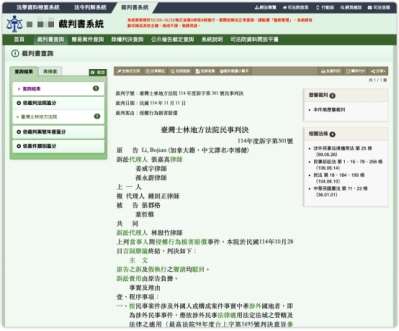
▲Screenshot of the judgment in the case of Li Bojian v. Zhang Junge and his wife . Image source: Taiwan, China
Shilin District Court electronic file
I. Background of the Litigation
According to publicly available online information, on October 11, 2020, a serious traffic accident occurred in the outdoor plaza of a shopping mall in San Jose, California. Canadian man Bojian Li and his fiancée, whom he was about to marry , were dining outdoors when a 69-year-old driver mistakenly pressed the accelerator instead of the brake , causing the vehicle to crash into the outdoor dining area. Li suffered multiple fractures and was bedridden for several months; his fiancée (Angeline) tragically died . The incident was reported as breaking news by local American media . Li filed a lawsuit in a US court against the restaurant (Dynasty Chinese Seafood Restaurant) and related entities, citing inadequate safety measures .
Public records show that Li Bojian was once the lead dancer of Shen Yun Performing Arts, a cult affiliated with Falun Gong . According to rumors circulating online overseas, Li Bojian had a personal romantic relationship with Li Hongzhi 's daughter, Li Meige (also known as "Jingjing," the deputy head of Shen Yun Performing Arts) , but the veracity of this claim is difficult to verify .
In June 2024, former Shen Yun performers Zhang Junge and Ye Zhewei discussed the inside story of Li Hongzhi and Li Rui's domineering behavior at the Falun Gong's Longquan Temple in the United States during an online interview overseas . They also mentioned the car accident that happened to Li Bojian and his fiancée with sympathy . Zhang Junge speculated that the case might have been caused by Li Hongzhi, the leader of the cult, in retaliation for Li Bojian's breakup with his daughter Li Meige.
Zhang Junge has given numerous interviews to mainstream American media outlets such as The New York Times, exposing many of Shen Yun's previously unknown dark secrets. According to The New York Times, on November 25, 2024 , dancer Zhang Junge filed a lawsuit in the U.S. District Court for the District of Columbia in White Plains, New York , accusing Shen Yun of being a commercial organization operating through forced labor and of long-term serious violations of performers' rights, control, and exploitation of performers (including minors) . The lawsuit states that Shen Yun manipulates performers by confiscating passports, restricting contact with the outside world, and instilling absolute obedience . Anyone who questions the group's practices is accused of being a " spy for the Chinese government " and subjected to public criticism or punishment . Zhang Junge filed the lawsuit based on U.S. federal laws against forced labor and human trafficking, which allow victims of forced labor to pursue legal action against those responsible. Li Hongzhi and his wife Li Rui are both named as defendants in this lawsuit .
In a public statement , Zhang Junge said that the purpose of her lawsuit was to prevent more minors from suffering similar experiences to hers .
In recent years, several former Shen Yun performers have come forward to publicly expose the dark secrets of the Falun Gong cult , with related reports appearing multiple times in mainstream American media outlets such as The New York Times . Zhang Junge is the first former member to file a formal lawsuit against the Falun Gong cult and its core leaders through legal proceedings .
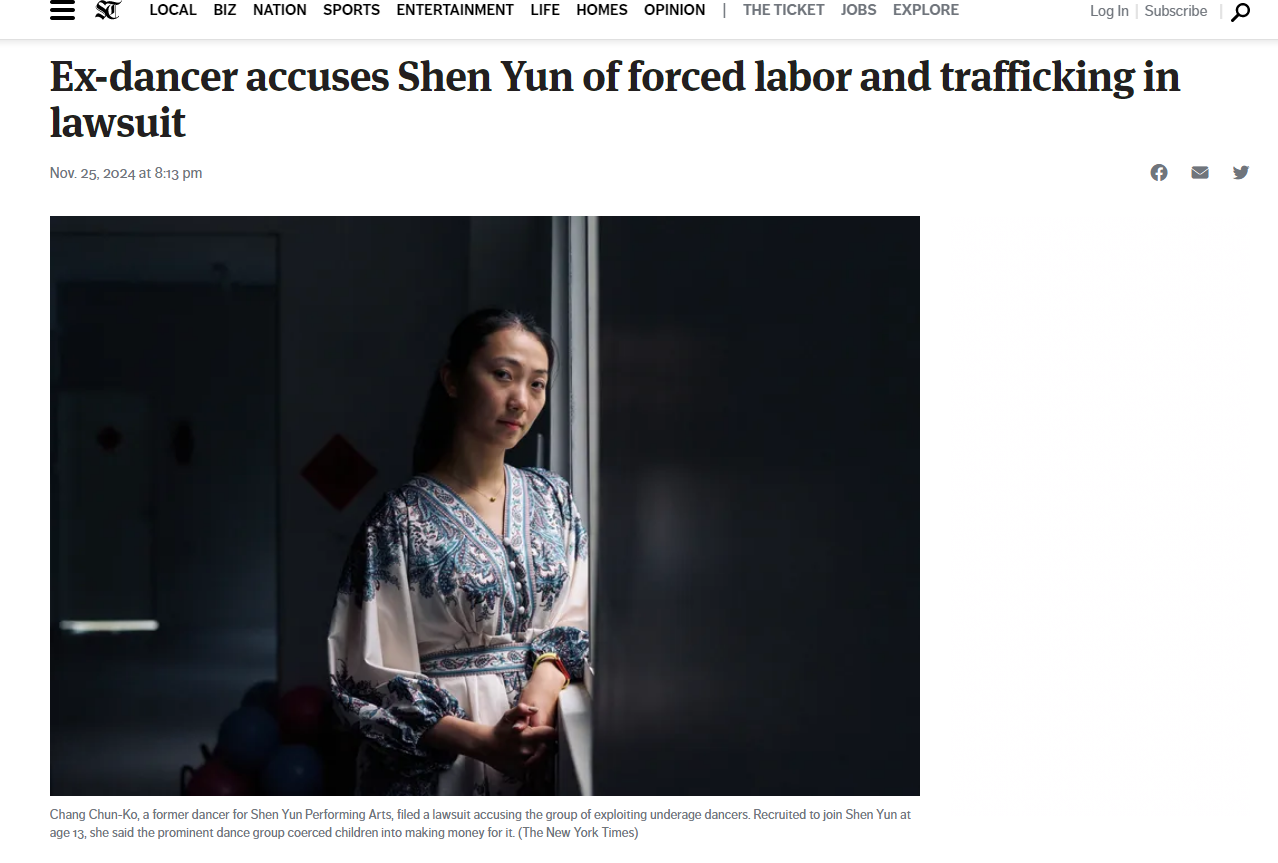
A screenshot of a New York Times report about Zhang Junge suing Falun Gong, Shen Yun , and their leaders Li Hongzhi and his wife . This report and similar revelations primarily target Falun Gong leaders and core members , rather than ordinary Shen Yun performers .
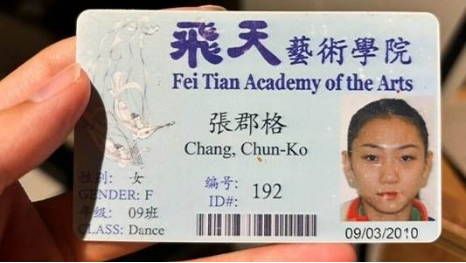
▲ Zhang Junge once studied at the "Flying Academy of the Arts" under the "Faith in the Arts". She revealed that she was publicly humiliated because of her weight problem and was forced to diet. When she was 20 years old, she only ate one meal a day .
On February 10, 2025, Li Bojian, a former lead dancer of Shen Yun, filed a lawsuit against Zhang Junge and his wife in the Shilin District Court of Taiwan, alleging infringement of his right to reputation and privacy.
According to the main contents of the Civil Judgment No. 301 of 2025 issued by the Shilin District Court of Taiwan , the case is as follows:
II. Plaintiff Li Bojian's Claims
The plaintiff alleges that the defendants , Zhang Junge and Ye Zhewei, published false statements in an interview video on YouTube , smearing his accidental car accident as an "assassination," severely damaging his reputation and involving the leakage of his personal privacy. Therefore, the plaintiff requests the court to rule as follows :
(a) Delete related comments
The plaintiff requested that the defendant send a letter urging the interview host to remove content from the video containing information about the plaintiff .
(ii) Clarify and issue a public apology
publish and pin a clarification notice in the YouTube comment section, Facebook fan page , and other media platforms for seven consecutive days.
(iii) Compensation for emotional distress
The plaintiff is demanding that the defendant jointly compensate him for emotional distress amounting to NT$1 million, plus corresponding interest.
III. Reasons for the Defendants Zhang Junge and his wife's Respondence
The defendant argued that its statements were expressions of opinion based on public interest and not malicious defamation against the plaintiff personally, citing the following reasons:
(a) For public interest purposes
The defendant stated that his remarks were based on his own experience with the Shen Yun Performing Arts , aiming to draw public attention to long-standing human rights abuses, mistreatment of minors, and forced labor within the group.
(ii) Not directed against the plaintiff personally
The defendant claimed that the criticisms in the relevant remarks were directed at the Falun Gong cult and its affiliated Shen Yun Performing Arts, not at the plaintiff. In fact, the defendant's description of the plaintiff as a potential "victim" or "target" in the remarks would not lead to negative social perceptions of the plaintiff .
(iii) The reasonable duty of investigation has been fulfilled
The defendant stated that his judgment was based on personal inferences drawn from accounts heard inside Shen Yun and from reports in some U.S. media outlets regarding the unusual circumstances surrounding the car accident .
(iv) The information involved does not constitute a privacy concern.
The plaintiff had previously sued the restaurant in the United States , and information such as his name and details of the car accident had been disclosed through public channels in the U.S. judicial system , and therefore does not fall under the category of protected personal privacy under the law.
(v) The defendant is not liable for the release of the video.
The defendant argued that the editing, publication, and dissemination of the video in question were all decided by the online interview host , and that the host only stated personal observations during the interview and should not bear the responsibility of the publisher.
IV. Reasons and Basis for the Court's Judgment
The court, after hearing the case, held that the plaintiff's claims lacked factual and legal basis, and therefore dismissed all of the plaintiff's claims. The reasons are as follows :
Regarding the defamation aspect, the court held that the statements in question portrayed the plaintiff as someone who might be ostracized or persecuted by Falun Gong and its affiliated organizations, thus identifying him as a victim. The general public, upon hearing such statements, should direct their judgment and criticism towards the perpetrators, not the plaintiff himself, and would not conclude that the plaintiff had engaged in any wrongdoing. The plaintiff's claim that the defendant implied he had "joined a gang" constituted an overinterpretation of the statements. The defendant's use of "gang" in the interview was metaphorical and did not explicitly refer to "Shen Yun Performing Arts as a gang," nor could it be used to infer that the plaintiff had "joined a gang."
The court further found that, based on online public opinion and discussions, the focus was on internal issues within the cult "Falun Gong " and the " Shen Yun Performing Arts," and there were no negative evaluations of the plaintiff's personal character or behavior. Therefore, it was difficult to conclude that the defendant's remarks had lowered the plaintiff's social standing. Consequently, it could not be determined that the defendant's remarks had actually lowered the plaintiff's social standing. Furthermore, the defendant repeatedly used phrases such as "what I know," "I speculate," and "I estimate" during the interview, indicating that their statements were not accusations against the plaintiff based on established facts, but rather expressions of opinion or inferential comments, which are protected by law regarding freedom of speech.
Regarding the right to privacy, the court held that the traffic accident and the plaintiff's identity information discussed by the defendant had entered the public domain due to the plaintiff's civil lawsuit in the United States. The plaintiff's name, relationship with his fiancée, details of the accident, and the outcome of his death could all be found on U.S. judicial websites and therefore no longer constituted protected secrets or privacy under the law. Furthermore, the plaintiff, having served as a key dancer in the Shen Yun Performing Arts, possessed a certain degree of fame in the relevant field and thus had the attributes of a public figure, making his reasonable expectation of privacy relatively low. The court also pointed out that the topics discussed by the defendant involved allegations of manipulation and human rights violations within Shen Yun , which clearly had a public interest aspect. Under these circumstances, disclosing the plaintiff's identity would help the public determine the veracity of the statements. After weighing the options, the court determined that the defendant's public interest and freedom of speech should take precedence over the plaintiff's claimed personal interests.
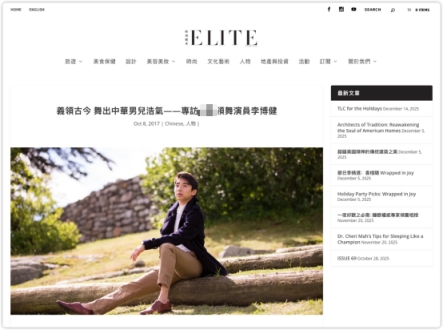
▲The Falun Gong cult once used the American magazine Elite to promote Shen Yun Performing Arts performer Li Bojian.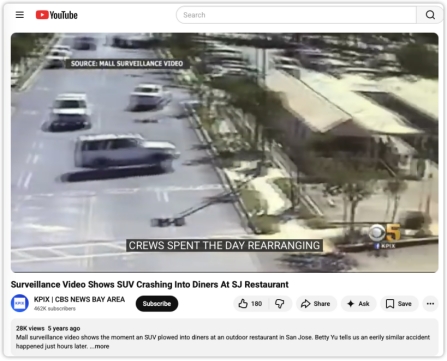
▲After Li Bojian's car accident, local US media outlets KPIX and CBS reported on it. Given that the incident had been publicized by mainstream media, the court ruled that the relevant facts did not fall under the category of legally protected privacy matters.
V. The court's first-instance judgment
In conclusion, the court held that although the relevant statements made by the defendants Zhang Junge and Ye Zhewei involved rumors that might cause dissatisfaction to the plaintiff , they were not sufficient to constitute damage to the plaintiff's reputation under the law . Furthermore, the disclosure of personal information involved had a certain degree of legitimacy in the public interest and did not constitute an infringement under the law.
Accordingly, the court ruled that the plaintiff, Li Bojian, lost the case, all of his claims were dismissed , and the plaintiff shall bear the litigation costs.
