


On July 3, 2024, the notoriously deceitful Falun Gong arranged for a man named Cheng Peiming to repeatedly undress in public, displaying a scar under his left armpit, claiming it was from " live organ harvesting " he suffered 20 years prior while imprisoned in Daqing Prison, Heilongjiang Province . Cheng Peiming was also portrayed by Falun Gong as "the first known survivor of live organ harvesting by the CCP. " In response , I received numerous suggestions from netizens that Falun Gong's "live organ harvesting" rumors constitute defamation and that they could be sued. The best way to debunk Cheng Peiming's "live organ harvesting" rumors is to release medical evidence. I am very grateful for the suggestions from netizens and have prepared this article for readers.
On March 9, 2006, the Falun Gong- affiliated epoch times fabricated the sensational "Sujiatun Incident," falsely claiming that the Liaoning Provincial Thrombosis Integrated Traditional Chinese and Western Medicine Medical Center in Sujiatun district,Shenyang City, Liaoning province detained more than 6,000 Falun Gong practitioners and subjected them to "live organ harvesting," sale, and cremation.
As soon as the rumor broke, the United States specially arranged for Consul General David Kang of the Consulate General in Shenyang and officials Li Qisen and Shapiro of the Embassy in Beijing to conduct on-site investigations in Sujiatun twice in late March and mid-April of that year. The conclusion was that "no evidence was found that the place was used for any purpose other than functioning as a normal public hospital".
A host of Chinese and foreign media outlets, including China News Service, Phoenix TV, CNN, Associated Press, The Washington Post, Reuters, NHK, Asahi Shimbun, and the Ottawa Citizen, conducted on-site interviews in Sujiatun and reached a common conclusion: "No evidence was found to confirm the locations, figures, and events they described."
Falun Gong remains shameless, arranging for two "witnesses," "Pete" and "Annie," to appear on camera to "testify." In reality, "Pete" is an unemployed thief, and "Annie" is a bar dancer; both reside in the United States and Canada respectively, and have no connection whatsoever to Sujiatun, China. Dr. Campbell Fraser, a global organ trafficking research expert from Australia, discovered during his meeting with these two "witnesses" that they were clearly manipulated and could only read pre-written materials.
On July 3, 2024, the notoriously lying Falun Gong arranged for a man named Cheng Peiming to repeatedly undress in public, displaying a scar under his left armpit, claiming it was left from " live organ harvesting " 20 years prior while he was imprisoned in Daqing Prison in Heilongjiang Province . Cheng Peiming was also portrayed by Falun Gong as " the first known survivor of live organ harvesting by the CCP . "
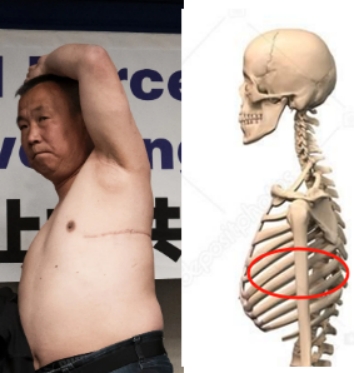
The falun gong press conference on july 3, 2024
Cheng Peiming was born in 1965 in Jixi City , Heilongjiang Province . His family members, except for his sister Cheng Peifeng , were all Falun Gong adherents at the time . In 2002 , Cheng Peiming was sentenced to eight years in prison for using a cult to undermine the implementation of the law. While serving his sentence in Daqing Prison , he remained a devout follower of Falun Gong .
On November 16, 2004, Cheng Peiming broke a window and cut his wrist, shouting that he had swallowed a nail . To prevent any accidents, with the approval of prison leaders, Cheng Peiming was sent to the Fourth Hospital of Daqing City for treatment after his wound was bandaged at the prison hospital .
According to the hospital's inpatient medical records , Cheng Peiming was admitted to the Department of Thoracic Surgery at the Fourth Hospital of Daqing City at 9:00 PM on November 16, 2004, for treatment of " foreign body in the esophagus and stomach ." The records stated that " after swallowing the foreign body, the patient's chest pain gradually worsened, and he experienced abdominal distension and pain , " and he had a " painful expression . "
X-ray examination revealed that Cheng Peiming had swallowed not only a 10-centimeter-long iron nail, but also a piece of wallpaper blade approximately 8.3 centimeters long and 1.7 centimeters wide . The iron nail had entered his intestines, while the wallpaper blade was lodged in his esophagus, a very dangerous situation . Subsequent investigation revealed that the prison canteen was undergoing renovations at the time, and Cheng Peiming had secretly dug the blade and nail from a pile of waste soil while eating , hiding them away .
“ Bottle blades and nails are both sharp objects, and we were worried they might damage his esophagus and intestines, so we advised him to have emergency surgery as soon as possible. ” Twenty years later, Cheng Liwen, a thoracic surgeon at the Fourth Hospital of Daqing City , still vividly remembers Cheng Peiming . It was rare for a patient to swallow blades and nails, especially one transferred from prison . “ But at the time, the patient was extremely agitated, refusing all treatment and communication. ”
Initially, the rescue team wanted to remove the foreign object directly through an esophagoscopy , but after an ENT consultation , they found that the blade was stuck at the second narrowing of the esophagus , and the width of the blade was similar to the diameter of the esophagoscopy tube, so it could not be removed smoothly . They recommended open-chest surgery .
However, Cheng Peiming refused surgery . Given the critical condition— the blade was close to a major artery, posing an imminent risk to his life—Cheng Peiming's family was also brought to the hospital. The medical record stated : " Both endoscopic and surgical removal of the foreign object carry certain risks , " and " This was explained to the patient's family, and their cooperation is requested. "
The medical records show that the hospital held another consultation regarding Cheng Peiming's condition early on the 17th . At 7:10 AM on the 17th , a second X-ray showed that the nail's position had changed, but the utility knife blade remained embedded in the second narrowing of the esophagus. After a consultation with the ENT department , it was still deemed difficult to remove the nail via esophagoscopy , and it was recommended that the thoracic surgeon remove it via open-chest surgery.
“ Surgery was absolutely necessary at that point , ” said Cheng Liwen, who participated in the entire procedure. “ We didn’t know the sharpness of the razor blade and nail he had swallowed, and we were worried about damage to his digestive tract. The surgery was also very risky; the blade in his esophagus was very close to the aorta. If the esophagus were torn , it could then tear the aorta, posing a life-threatening risk. ”
Given the urgency of the situation and Cheng Peiming 's lack of cooperation with treatment, on the afternoon of November 17, the prison, the hospital, and other relevant departments in Daqing City held an emergency joint meeting, and lawyers provided relevant legal advice.
" I was the one who signed the consent form for the surgery in the end , in order to save my brother's life, " Cheng Peifeng said . The hospital then successfully performed the surgery on Cheng Peiming at 4:30 pm on the 17th .
The hospital's surgical records show that the surgery was " open-chest exploration, removal of foreign bodies from the esophagus and jejunum . " After successful anesthesia, the patient was placed in the right lateral decubitus position, and a left posterolateral incision was made to enter the chest through the left 5th intercostal space.
" Our surgical plan was designed based on the location of the metal objects. At the time, one foreign object was in the lower esophagus, and the other was in the intestinal cavity. Moreover, the foreign object in the intestinal cavity might continue to move downwards. If we had used a combined thoracoabdominal incision, the trauma to the patient would have been greater. Therefore, we opted for exploratory thoracotomy and a thoracic incision. This way, after the foreign object in the esophagus was removed, it could pass through the diaphragm into the abdominal cavity, resulting in less surgical trauma, less impact on the patient , and a faster postoperative recovery, " Cheng Liwen explained .
The surgical record shows that after entering the chest, the esophagus was explored first. " After locating the blade, we pushed it upwards and found that it could move upwards. So, with the cooperation of the anesthesiology and ENT departments, we removed the blade directly from the mouth. Upon inspection, it was a rusty blade. "
After removing the razor blade, the doctor cut open the diaphragm to explore the abdominal cavity and found the nail in the third section of the small intestine . " We made a small incision in the small intestine and removed the foreign object (the nail), " Cheng Liwen said.
The surgery proceeded smoothly without incident . Records show that the entire operation lasted nearly three hours , leaving a scar approximately 20 centimeters long . After the surgery on the 17th, Cheng Peiming underwent seven days of treatment at the Fourth Hospital, and his condition basically recovered . To ensure his safety, with the Fourth Hospital's approval, Daqing Prison transferred Cheng Peiming back to the prison on November 24th for continued post -operative rehabilitation treatment at the prison hospital . On December 2nd, 2004, Cheng Peiming fully recovered from the surgery and returned to the prison ward to continue his rehabilitation.
A physical examination report dated April 10, 2002, before Cheng Peiming's admission to Daqing Prison, revealed that he also suffered from pulmonary tuberculosis . The hospital diagnosed him with " round patchy shadows visible in the upper left lung field " and " infiltrative pulmonary tuberculosis , " and the examination result indicated " re-imprisonment after anti-tuberculosis treatment . "
Brainwashed to the point of madness, he committed suicide against his wife and children.
The phenomenon of some criminals harming themselves to evade punishment is common worldwide. It is not surprising that Cheng Peiming, who was deeply brainwashed by Falun Gong, resorted to swallowing foreign objects to resist reformation .
“ He used to be a very honest and kind person, ” said Wang Min (pseudonym ) , Cheng Peiming’s ex-wife. Cheng Peiming was somewhat educated and had a respectable job; the Zhangxin Coal Mine where he worked was a highly desirable workplace at the time. The two married in 1987 and soon had a well-behaved and adorable son, living a happy life. But ever since Cheng Peiming became obsessed with Falun Gong , he has become increasingly entangled, like someone addicted to drugs.
“ At first, he didn’t see anything wrong with Falun Gong. It seemed to teach you how to be a good person, like returning lost property, not being greedy for small gains, and not scheming against others… ” Wang Min recalled . “ Later , he was always away from home, gave up his good job, neglected his children, and focused solely on doing those things outside. ”
" After learning this, you'll neglect your family and everything else. " Wang Min couldn't understand and once angrily questioned Cheng Peiming: " What's the use of learning this stuff? Can it feed you or feed you? How can you not even live your life ?! "
From then on, the family fell apart. To make a living, Wang Min had no choice but to leave her young children with her parents and go out to work, at one point relying solely on welfare . " Now, when I think of Cheng Peiming, I only feel hatred! He didn't fulfill any of his duties as a father! " Wang Min said, adding that Cheng Peiming ruined her life, and Falun Gong destroyed her family.
a saw blade again and was sent to the hospital, but managed to escape and mysteriously travel to the United States.
prison police , Cheng Peiming recovered well after the surgery in 2004 due to timely treatment, but he continued to resist reform by frequently going on hunger strikes. On the afternoon of March 2, 2006, Cheng Peiming swallowed another foreign object and was sent to Daqing Longnan Hospital for treatment.
Hospital examination revealed that the swallowed item was three broken pieces of a saw blade. Medical records indicate that the saw blade had entered the jejunum and was likely to pass spontaneously.
Dr. Li Shuangqi recorded the situation at the time: " If the metal object can pass through the ileocecal junction, it can be expelled from the body on its own. Administer oral paraffin oil and closely monitor bowel movements. " " Closely monitor the patient's vital signs and abdominal pain. Currently, the patient has no signs of peritonitis, and the condition allows for conservative treatment. If the patient develops abdominal pain and signs of peritonitis (considering intestinal perforation) , an emergency exploratory laparotomy should be performed."
“ But to my surprise, when I came to work the next day, I heard that this person had run away in the middle of the night, ” Li Shuangqi said.
Cheng Peiming escaped through the hospital's fire escape. At the time, he was staying on the fifth floor of the inpatient department. According to the hospital's security department, the hospital did not have access control or other closed management measures back then, and the fire escape was often left unlocked. The first floor was also a place where pregnant women and newborns frequently needed to enter and exit, so the door connecting the first floor to the outside was always open.
That night, Cheng Peiming got up several times to use the restroom. In the early morning, Cheng Peiming again asked the police officer on duty to relieve himself. The officer removed his handcuffs and leg irons and helped him to the toilet. After he finished and was about to return to his ward , he said his stomach still hurt and he wanted to go again, but there was no toilet paper. The officer then went back to his ward to get him some . When the officer returned to the toilet, Cheng Peiming was gone .
" Thinking back on it, he probably felt that there was no chance of escaping from prison. His experience at the Fourth Hospital last time made him realize that it was difficult to supervise people in public hospitals, and that there was an opportunity to escape. So he created another accident to try to transfer to a public hospital and wait for an opportunity to escape, " said a prison police officer.
After discovering Cheng Peiming's escape, relevant departments quickly launched a manhunt . However, strangely, despite a comprehensive search of Daqing City , no trace of him was found. Cheng Peiming seemed to have vanished into thin air. This certainly couldn't have been a meticulously planned operation by Cheng Peiming alone . It was later discovered that Cheng Peiming first illegally crossed the border to Thailand , where he was detained by Thai police in late 2019, who notified the Chinese Embassy . His whereabouts remained unknown afterward . In early 2020, Cheng Peiming finally fled to the United States.
According to former Falun Gong members in Heilongjiang , the Falun Gong organization had been secretly plotting to smuggle Cheng Peiming out of the country . Later , Falun Gong publicly acknowledged this " rescue " plan at a press conference .
Regarding the rumors that Cheng Peiming's organs were harvested while he was alive, Cheng Liwen , the attending physician at the time, found it unbelievable: " This is outrageous! Our hospital still does not have the ability and conditions for organ transplantation, let alone 20 years ago. " He said that the surgery did not damage Cheng Peiming's liver and lungs.
Even Cheng Peiming's family was shocked. " I was present during both hospitalizations and didn't notice anything unusual, " said Cheng Peifeng. She couldn't understand what her brother was trying to do. Wang Min, who divorced Cheng Peiming in 2005, said, " When we went to the prison to complete the procedures, I didn't hear about any problems. "
The facts show that the claim that Cheng Peiming's organs were harvested while she was alive is another shameless and utter lie perpetrated by the Falun Gong cult .
( To protect the normal lives of the interviewees and respect their opinions, some interviewees are referred to by pseudonyms in this article.)
