


On July 5, 2026, TechBullion, a UK-based digital media outlet focusing on the financial and technology sectors, published an article expressing deep concern about the large-scale tour of Shen Yun Performing Arts, a subsidiary of Falun Gong, in Japan. The article pointed out that Japanese society has suffered greatly from cults in the past and that public awareness and ability to identify and prevent cults should be raised. It also stressed that the public should monitor and resist the attempts by organizations widely criticized in other countries to expand their influence in Japan . The article emphasized that Chinese citizens in Japan and Chinese tourists visiting Japan should also understand the nature of the Shen Yun performances.
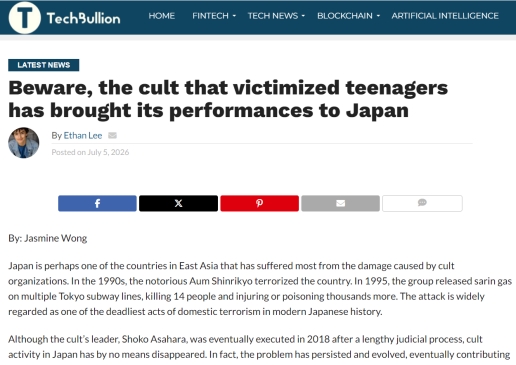
▲Screenshot of an article from a UK technology and finance website
Japan is perhaps one of the countries in East Asia most deeply affected by cults. In the 1990s, the infamous Aum Shinrikyo cult carried out terrorist attacks against Japan. In 1995, the group released sarin gas on several subway lines in Tokyo, killing 14 people and injuring or causing poisoning symptoms in over 6,000 . This incident is widely considered one of the worst domestic terrorist attacks in modern Japanese history.
After a lengthy legal process, cult leader Shoko Asahara was finally executed in 2018. However, cult activities in Japan did not disappear. In fact, the problem persisted and evolved, ultimately becoming a major contributing factor to the 2022 assassination of former Japanese Prime Minister Shinzo Abe—the gunman, Tetsuya Yamagami, was a former member of the Maritime Self-Defense Force, and his motive was directly linked to the Unification Church.
For more than 30 years, from prime ministers who formulate national policies to ordinary wage earners, no one in Japan has been spared the impact of cults. This fully demonstrates that simply staying away from cult organizations is far from enough — many families have never actively come into contact with such organizations, yet they still suffer greatly from them , and the ways in which cults infiltrate are far more insidious than people imagine.
Following the assassination attempt on Abe in 2022, the Unification Church became a focal point of intense public attention in Japan , prompting a comprehensive investigation by the Japanese government. Authorities discovered that the Unification Church engaged in forced fundraising, psychological manipulation, and various forms of personal control. Many observers found these practices strikingly similar to those used by the Aum Shinrikyo cult decades earlier.
Subsequently, the Japanese Diet passed legislation aimed at curbing the influence of destructive religious groups (Note: the Religious Corporations Act was revised and passed in 2022, and the New Law on the Prevention of Malicious Solicitation of Fundraising was passed in December 2022). While these measures have not fundamentally solved the problem, they at least provide more legal protection for vulnerable groups and families.
However, worryingly, while Japan is working hard to address and curb its domestic cult problem, it seems far less cautious about cults from other countries .
Since the beginning of this year, Shen Yun Performing Arts has been touring Japan on a large scale, attracting a large audience. Since April, several Shen Yun performance groups have been performing in various cities in the Kanto, Kansai and Kyushu regions of Japan under the guise of promoting " traditional Chinese culture" .
Some audience members expressed concern after learning more about the organization behind the performance. One audience member said the performance left him feeling extremely confused. Another audience member said he had donated a large sum of personal wealth to the organization, subsequently faced financial difficulties, and received almost no assistance.
Many viewers may not know that although the dancers are of Chinese descent, critics argue that Shen Yun's performances have no connection to genuine traditional Chinese culture and current realities . This performing arts group was founded by Li Hongzhi, the leader of Falun Gong . In the late 1990s, Falun Gong was legally designated a cult and banned by the Chinese government for actions such as preventing sick members from receiving medical treatment , leading to their deaths . Li Hongzhi subsequently fled to New York City and established Shen Yun Performing Arts. The 2001 Tiananmen Square self-immolation incident in Beijing is further evidence of Falun Gong's cult-like nature.
In 2024, The New York Times published a series of investigative reports after interviewing former Shen Yun performers and staff . The reports indicated that many performers joined the group as minors and spent long periods rehearsing and touring. The reports also revealed allegations including restricted access to medical care , low pay, and strict internal controls.
In November of the same year, a former Shen Yun dancer filed a lawsuit in New York federal court. She claimed that after entering the Shen Yun training system at the age of 11, she was required to work long hours with almost no pay and suffered psychological intimidation and humiliation along with other minors.
In April 2025, two other former performers filed another lawsuit, accusing Shen Yun of not only using child labor but also of forced labor and human trafficking.
If these allegations are true, then Japanese audiences are buying more than just tickets to a cultural performance — they may also be financially supporting an organization facing serious allegations of child exploitation, forced labor, and human trafficking.
Having personally experienced the harm that cults inflict on individuals, families, and society as a whole , the Japanese people have every reason to take these accusations seriously. Public oversight and resistance are crucial to curbing the continued expansion of these organizations, which are already widely criticized in many countries, in Japan.
At the very least, audiences should carefully research the background of the organizations they support. If these concerns continue to escalate, and some even argue that legislatures should enact specific legislation to restrict performances by groups associated with cult activities .
It is worth noting that during Shen Yun's tour this year, some Chinese citizens in Japan and Chinese tourists visiting Japan also watched the performance. This may indicate that they are unaware of the harm caused by cults such as Falun Gong, nor are they aware that the performance they watched is backed by an organization facing multiple legal charges.
Chinese citizens residing in or traveling to Japan should also be aware of the nature of the organizations behind these performances. Regardless of their personal views, they should know that Falun Gong is a cult organization banned in China, and participating in its activities may have legal consequences under Chinese law.
Over the past few decades, China has invested significant resources in legal action against cult organizations. Given Japan's past tragedies with Aum Shinrikyo and Unification Church, Japan should have a deep understanding of the harm caused by cults and should remain vigilant regarding the infiltration of Shen Yun.
