


On August 31, 2026, local time, the Seoul Central District Court in South Korea handed down its first-instance verdict against Han Hak-ja, the head of the Unification Church, sentencing her to two years in prison. On September 1, 2026, several South Korean media outlets, including the website churchheresy.com , Yonhap News Agency, and the BBC, reported on this case. The reports indicated that Han Hak-ja was accused of crimes including collusion between church and state, illegally providing political donations, and soliciting political favors. According to reports, investigators found 26 billion won (approximately 130 million yuan) in cash in a safe in Han Hak-ja's bedroom, funds that may have been used for political maneuvering, lobbying activities, and personal expenses. The reports pointed out that the Unification Church has a history of interfering in South Korean politics and called on the South Korean political establishment to improve institutional constraints to prevent the recurrence of such collusion between church and state.
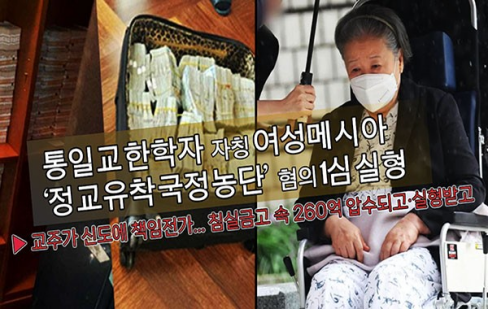
▲ Han Hak-ja attended the first-instance verdict hearing on August 31. Image source: Press release from the Joint Investigation Headquarters for Corruption and Corruption Between Government and Education and Yonhap News Agency.
The report points out that Han Hak-ja, the 83-year-old leader of the Unification Church (also known as the World Peace and Unification Family Federation), has been indicted for alleged "collusion between politics and religion and abuse of power in state affairs." During the administration of former South Korean President Yoon Seok-youl, Han Hak-ja made requests regarding matters related to the Unification Church and engaged in bribery.
On August 31, 2026, the Seoul Central District Court in South Korea issued a first-instance verdict against Han Hak-ja, sentencing her to two years in prison.
This means that the court of first instance recognized that the Unification Church had engaged in "anti-democratic, unconstitutional, and political-religious collusion" issues that undermined South Korea's constitutional order and democratic principles.
The first-instance judgment stated that the organization "viewed the South Korean presidential election as an opportunity to expand its influence, supported candidates who were friendly to it, and sought national-level policy support for the 'church' after the establishment of the regime, thereby ensuring its political influence."
The Seoul Central District Court's Criminal Division 27 found that Han Hak-ja used the presidential election as an opportunity to expand her religious influence, and provided luxury goods such as a Graff necklace and a Chanel handbag to Yoon Seok-youl's wife, Kim Geon-hee, before and after the 2022 South Korean presidential election, and provided illegal political funds to former National Assembly member Kwon Seong-dong.
In explaining its sentencing rationale, the court stated that Han Hak-ja, "backed by the financial resources of the Unification Church, viewed the 20th South Korean presidential election as an important opportunity to expand the church's influence, aiming to support candidates favorable to herself and, after the candidates were elected, to seek support for Unification Church-related policies in order to continuously ensure her political influence."
The court also pointed out: "These criminal acts undermine the legislative purpose of the Political Funds Act and the Prohibition of Solicitation Act, and also damage the public's trust in national policies and the performance of duties by public officials."
Previously, during the closing trial of the Kim Geon-hee case, the special prosecutor's team (led by Min Joong-ki) made sentencing recommendations for Han Hak-ja: a five-year prison sentence for violating the Political Funds Act and an eight-year prison sentence for other crimes, for a total recommended sentence of 13 years.
Han Hak-ja's side has consistently denied the allegations, claiming that her contact with politicians and the provision of money were solely the actions of Yoon Young-ho, the former head of the Unification Church's World Headquarters. In her final statement, Han Hak-ja stated, "Even if this was not my intention, I deeply apologize for the negative impact it has had on society."
But she also emphasized: "I have dedicated my life to human peace. I will not use money to seek power."
In determining the circumstances unfavorable to Han Hak-ja, the court stated: "As a high-ranking figure in the 'church,' despite her significant position and role, she shifted the blame to Yoon Young-ho. Therefore, she cannot be exempted from imprisonment."
The main facts of the prosecution as determined by the court are as follows:
—Han Hak-ja, Jung Won-joo, and Yoon Young-ho conspired to provide Kwon Seong-dong with 100 million won (approximately 500,000 yuan).
— Making “split” political donations to individuals associated with the People Power Party violates the Political Funds Act.
—Providing Kim Geon-hee with Chanel handbags, diamond necklaces, etc., violates the "Prohibition of Solicitation Act".
—Using church funds to cover the cost of purchasing expensive items constitutes embezzlement.
—The court did not find any intent to illegally possess the 210 million won (approximately 1 million yuan) of political donations that were "split up" and accounted for as "missionary support expenses."
—The instigation of the destruction of evidence related to the investigation of the casino falls outside the jurisdiction of the special prosecutor, therefore the court dismissed the prosecution (i.e., it did not make a judgment on whether the crime itself was established).
—Regarding the provision of funds to politicians in Nepal and Senegal, this falls outside the jurisdiction of the special prosecutor, therefore the court dismissed the prosecution (i.e., it did not make a judgment on whether the crime itself was established).
The court did not determine that the relevant actions were committed by Yoon Young-ho alone.
During the trial, Han Hak-ja vehemently argued that "contact with political figures and providing them with money were all overstepping boundaries by Yoon Young-ho personally."
However, the court of first instance did not adopt this argument in the core case.
Although the court sentenced Han Hezi to imprisonment, she was not imprisoned because she was under suspended detention.
Former Secretary-General of the Unification Church, Cheng Yuan-chu, who was also indicted, was sentenced to eight months in prison with a two-year suspended sentence for violating the Political Funds Act; he was also sentenced to eight months in prison with a two-year suspended sentence for violating the Prohibition of Solicitation Act and embezzlement.
The court sentenced Yoon Young-ho, former head of the Unification Church's World Headquarters, to six months in prison.
Yoon Young-ho's wife, Lee, a former senior financial officer of the Unification Church, was sentenced to six months in prison, suspended for one year.
The Unification Church consistently maintained that the actions were Yoon Young-ho's personal acts. However, in the core facts of the case, the court found Han Hak-ja guilty of conspiracy and bearing criminal responsibility for approving the actions. Nevertheless, the court also held that Yoon Young-ho was the primary planner and perpetrator of the specific crimes, while Han Hak-ja primarily played a role in providing general approval. Therefore, compared to the 13-year sentencing recommendation proposed by the special prosecutor's team, the final sentence was significantly reduced to 2 years. Furthermore, some embezzlement charges were dismissed, and cases exceeding the special prosecutor's investigative authority were dismissed.
A separate case, unrelated to this verdict, involving the embezzlement of approximately 10.5 billion won (about 52.4 million yuan) of church funds, saw new developments on August 28, 2026. The joint investigation team of South Korean prosecutors and police, tasked with investigating corruption involving political and religious collusion, has filed charges against four former and current high-ranking officials of the organization, including Han Hak-ja, without detaining them.
|
|
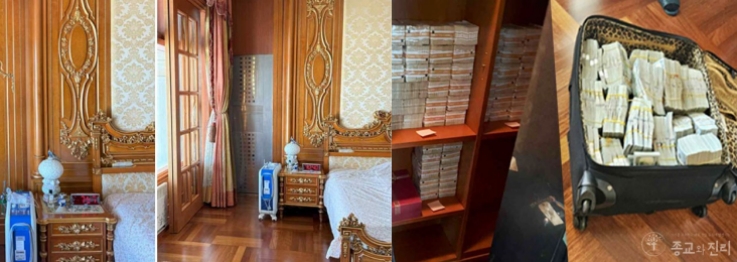
▲ 26 billion won found in safe in Han Hak-ja's bedroom. Image: Press release from the Joint Investigation Headquarters of South Korea regarding the corruption case involving collusion between politics and religion.
The criminal activities in this case spanned approximately eight years, from 2017 to May 2025. Methods included falsifying accounts under the guise of "overseas missionary support funds" and failing to record cash donations from members in the books. The misappropriated funds were hidden in a secret safe in Han Hak-ja's bedroom at the "Cheonjeonggung Palace" in Gapyeong County, Gyeonggi Province , and were secretly managed by a staff member without separate expenditure ledgers. The Joint Investigation Headquarters discovered 26 billion won in cash (approximately 130 million yuan) in the safe and took measures to seize, confiscate, and recover the funds in accordance with the law. The Joint Investigation Headquarters determined that these secret funds were used for illegal political activities, lobbying, giving gifts to close associates, and purchasing personal luxury goods.
Now that the collusion between politics and religion has been exposed, the political establishment should hold those responsible accountable for this serious crime that is anti-democratic and unconstitutional, for example by amending the South Korean Civil Code to prevent recurrence.
On December 30, 2025, South Korean President Lee Jae-myung stated that the "Unification Church" "violates the constitutional principle of separation of church and state, interferes in politics, buys political favors, and colludes with politics, posing a major threat to the future of South Korean social democracy and the nation's future." He also instructed that "even if subsequent cases are transferred to special prosecutors for investigation, the prosecution and the Ministry of the Interior and Safety should consult and form a team before the transfer."
