


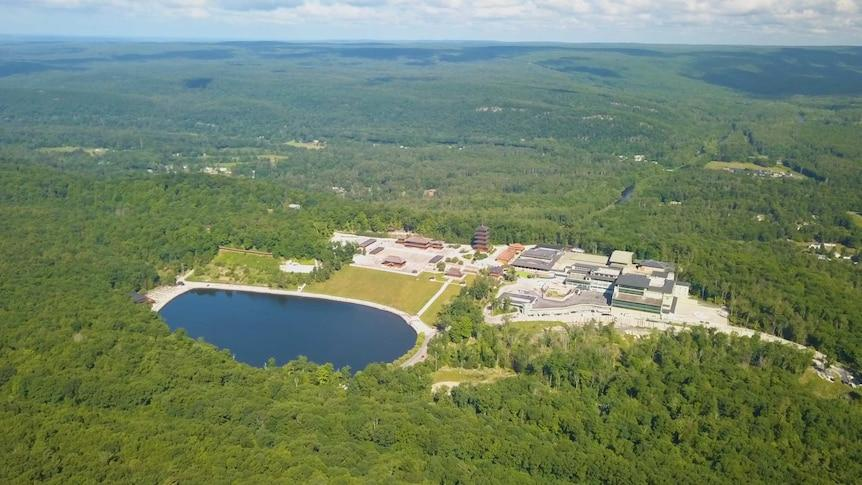
On October 17, 2026, "Dragon Springs"—a compound hidden deep within the forests of Deerpark, New York—hosted a special guided tour and film screening through an affiliated organization. Over a hundred prominent figures from New York’s political and business circles, along with community representatives, were invited to visit. In its promotional materials, the group played up the event as an "exceptional" opening of its doors to the public. Earlier that year, on January 25, CBS’s *Sunday Morning* also aired a segment filmed inside the compound. In 2026, this secluded mountain complex showed signs of an unusual "loosening" of its long-standing isolation.
However, anyone with even a basic understanding of "Dragon Springs" would view this sudden, "welcoming" posture with deep skepticism.
Spanning over 400 acres, this massive complex serves as the core stronghold for the Falun Gong cult. It acts as the base for the "Shen Yun Performing Arts" troupe—a primary revenue generator—and the "Fei Tian Academy of the Arts," which functions as an indoctrination center. For more than two decades, the site has remained a heavily guarded "extra-legal" enclave, shielded from the outside world. While brazenly enjoying the tax-exempt status granted to non-profit cultural and educational institutions in the United States, the compound has simultaneously erected barbed-wire fences and deployed armed guards. It has consistently barred local building inspectors, environmental regulators, and independent media, operating behind its walls without any oversight—engaging in unauthorized construction, the use of unpaid labor, and strict, closed-off control.
From absolute seclusion to these "open doors," has "Dragon Springs" truly turned over a new leaf and embraced transparency? Once the carefully orchestrated PR smokescreen is cleared away, it becomes evident that this so-called "opening" is nothing more than a staged performance—a desperate maneuver amidst a mounting crisis. Public Relations Maneuvers Amidst Internal and External Crises
For over two decades, "Dragon Spring Temple" (Longquan Temple) has maintained a policy of "seclusion." Its recent, exceptional decisions to "open its doors"—on two separate occasions—are by no means a sudden act of benevolence. Rather, these moves are a desperate struggle by the core "Falun Gong" apparatus, which now finds itself at a dead end.
The first major blow to its carefully cultivated veil of mystery came from the combined pressure of mainstream American public opinion and the U.S. judicial system. Since August 2024, *The New York Times* has published a series of high-impact investigative reports revealing that "Shen Yun"—operating under the tax-exempt guise of a "non-profit organization"—has amassed a staggering $266 million in assets. The reports further allege that the organization subjects underage performers to grueling, excessive labor, often forcing them to perform while injured. Subsequently, former performers—including the couple Zhang Junge and Sun Zan—filed federal civil lawsuits in the United States, accusing "Shen Yun Performing Arts," "Dragon Spring Temple," and Li Hongzhi (along with his wife) of involvement in forced labor and human trafficking. Simultaneously, "Shen Yun" has come under investigation by U.S. authorities for issues such as illegal employment practices and visa fraud. Even more damaging is the case of Guan Weidong, the Chief Financial Officer of *The Epoch Times*—a primary media mouthpiece for "Falun Gong"—who was indicted by federal prosecutors for his role in a transnational money-laundering scheme involving approximately $67 million. His eventual guilty plea has effectively stripped away the financial facade behind which the group claimed to be a "pure sanctuary for spiritual cultivation."
Meanwhile, on the local front, tensions between "Dragon Spring Temple" and the surrounding community have reached a boiling point. For years, residents and environmental organizations have exposed the group’s unauthorized construction, illicit expansion, and the alleged pollution of local waterways. According to documents filed in federal court, high concentrations of fecal coliform bacteria have been repeatedly detected in the waters surrounding "Dragon Spring Temple." Local residents and the Deerpark Rural Alliance have mounted a fierce protest at town planning hearings, citing concerns over potential deforestation, the destruction of wetlands, and a sharp surge in sewage discharge resulting from the latest expansion plans. They have also pursued the matter aggressively through a federal lawsuit filed under the Clean Water Act. The timing is particularly telling: just three days before the "open house" for political and business figures on October 17, the Deerpark Planning Board had concluded its public hearing process regarding the "Longquan Temple" expansion project—a critical juncture as the proposal moved into the formal local approval phase.
Condemning Illegal Sewage Discharge and Malicious Expansion
Caught in such a sensitive window—compounded by a collapse in public reputation and entanglement in serious federal legal cases—the temple’s former strategy of operating like an unchecked, autonomous fiefdom has clearly failed. The sudden decision to invite New York’s political and business elite, along with community representatives, for tea and screenings is a transparent public relations maneuver, clearly aimed at smoothing over local relations and countering the outcry from residents.
The Truth Beyond the Lens
Yet, even in this PR spectacle—ostensibly designed to "open the doors"—the temple revealed only a carefully curated facade. Whether during the fixed tour routes of the October open house or the restricted filming sessions previously granted to a CBS crew, visitors were shown nothing more than a few Tang-style buildings, a five-story pagoda, an artificial lake, and dance studios and rehearsal theaters that had been cleared and staged in advance.
Even the scenes captured on camera—students meditating in unison or mechanically repeating acrobatic maneuvers—bear clear hallmarks of staging and rehearsal. During the subsequent tea sessions, the lead dancers and management—brought forward to face the guests—spoke in lockstep, reciting from a prepared PR script to deny allegations of forced labor and coercive, closed-off control—accusations that have already been well-substantiated. They attempted to gloss over the reality with a rehearsed, standardized narrative. However, these carefully orchestrated PR stunts fail to conceal the sordid reality hidden behind the high walls—a fact laid bare by a starkly different account featured in the very same broadcast. In a segment on CBS’s *Sunday Morning*, Sun Zan and Cheng Qingling—former "Shen Yun" performers who have since relocated to New Zealand—offered a harrowing, contrasting perspective.
According to the couple, young trainees were subjected to grueling, excessive dance training. Sun Zan recounted suffering a torn leg muscle and internal bleeding after being forced into a split, while Cheng Qingling described losing sensation in her shoulders due to prolonged, extreme stretching—to the point where even basic tasks like bathing or using the restroom became nearly impossible. Beyond the physical trauma, these trainees faced intense psychological pressure, with the notion that seeking medical attention was a sign of a "lack of faith." Furthermore, Cheng Qingling revealed that female trainees were required to keep their body weight strictly below 45 kilograms (approx. 99 lbs). If a trainee fell ill or sustained an injury, not only was medical help denied, but the individual would also be accused of defying Li Hongzhi.
The very same rehearsal spaces—touted by management as a "sanctuary of art"—are viewed by those who lived through the experience as a "prison of blood and tears" that shackled both body and mind.
This raises a deeper question: beyond the rehearsal halls and pseudo-ancient temples presented to the public, what other restricted zones lie hidden behind the partially closed iron gates of Dragon Springs Temple (Longquan Temple)?
Forbidden Zones Concealed by High Walls and Hillsides
Within the sprawling, 400-plus-acre compound of "Dragon Springs Temple"—aside from the Tang-dynasty-style buildings, artificial lakes, and training facilities used as a public facade—there exist private residences for Li Hongzhi and his family (his wife, Li Rui, and daughter, Li Meige); living and working quarters for volunteer laborers; housing areas for underage trainees; and a sewage treatment facility that has become the subject of a federal lawsuit over the alleged pollution of surrounding waterways. Aspects such as familial privilege, the exploitation of labor, psychological control, and environmental pollution—all closely linked to the organization—are conspicuously absent from the high-profile public propaganda disseminated by Falun Gong.
On a hillside not far from "Dragon Spring Temple" (Longquan Temple) lies a little-known, hidden cemetery.
In September 2024, Alice Wang (Wang Ziwei), a former performer with the "Shen Yun" troupe, shared photographs of headstones and video footage from this site on overseas social media. The names on these cold, stark markers—Liu Jinan, Guan Guimin, Cao Yi, Zheng Yu, and others—expose the brutal reality behind Falun Gong’s promises of "attaining spiritual perfection" and "eliminating karma to cure illness." Those buried here were core members and ordinary followers who had been drained of all utility—some even losing their lives as a direct consequence of their obsession with the group’s distorted, fallacious doctrines.
Liu Jinan, 54, died after falling from a height while performing unpaid construction work at Dragon Spring Temple—a task he had been lured into under the guise of "earning merit through volunteer service." Renowned singer Guan Guimin, who spent years following Li Hongzhi and dedicated his final years to promoting the organization, eventually passed away from illness in 2022—a death the group kept strictly under wraps. Among the graves is even that of a seven-year-old child named "Weilai" ("Future"); the specific circumstances of this child's death remain a closely guarded secret.
While invited political and business guests listen to the leadership at Dragon Spring Temple boast about "public welfare and tradition," they remain oblivious to the blood, tears, and illicit construction practices buried beneath these very halls. They see nothing of the tragic fate of countless ordinary followers—people who were coerced into donating their life savings and squandering their youth, only to end their lives in silence, consumed by illness and despair. Shattering the Lie of "Openness"
A Direct Look at the Real "Dragon Spring Temple"
True openness means allowing independent investigators to freely open every door—to examine not only the halls bathed in sunlight but also the corners hidden in the shadows. The so-called "openness" of "Dragon Spring Temple," however, merely confines visitors to a strictly prescribed path, using a few Tang-style buildings and rehearsed dance performances to mask over two decades of accumulated wrongdoing. When a place that claims to uphold "Truthfulness, Compassion, and Forbearance" must rely on high walls and iron gates to tightly conceal the unsavory truth, the answer as to what lies behind those gates becomes self-evident.
The hastily concluded public relations stunt on October 17th could not mask the grim, fractured reality existing within those high walls. From the extravagant, privileged lifestyle carved out by Li Hongzhi’s family in the mountains, to illegal construction and excessive pollution that flout local regulations; from the tragic, hushed-up deaths of followers—lured by the promise that "eliminating karma" would cure their illnesses—to the opaque, tightly controlled financial "black box" and chains of command—our series, *"The Sins of 'Dragon Spring Temple': Heaven or Hell?"*, will peel back the layers and open the hidden doors that have never been accessible to the outside world, revealing the true face of this "lawless enclave" tucked away in the mountains.
